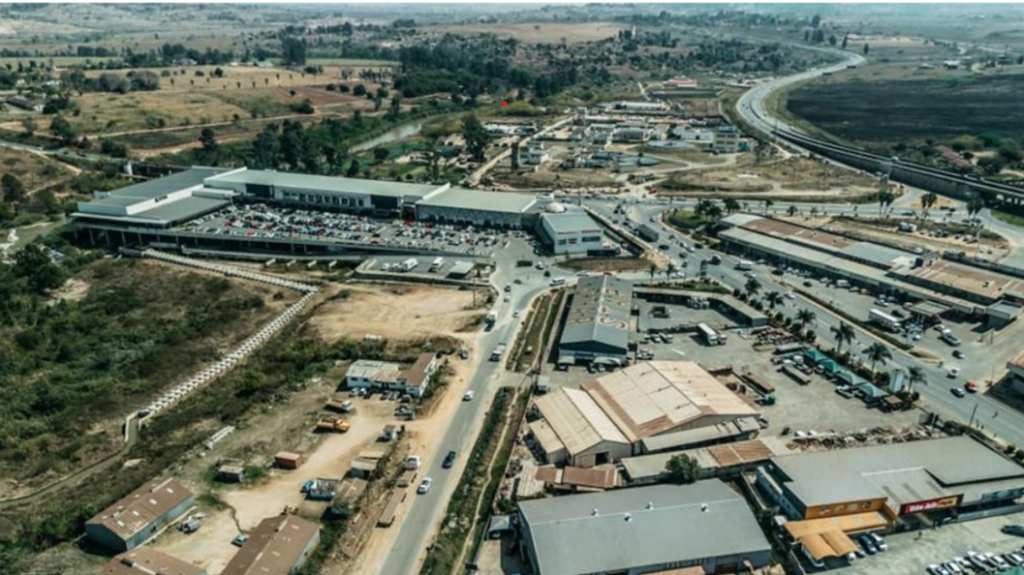
Few places tell Eswatini’s development story as powerfully as Matsapha. For decades, the town has been known as the Kingdom’s industrial heartbeat, driving manufacturing, trade, and logistics. But over the past 40 years, Matsapha has grown into far more than a factory zone. It has become a municipality with a distinct urban identity, a growing population, expanding infrastructure, and a clear ambition to position itself as a liveable, sustainable investment town.
Declared a Town Council in 2012 and administered under the Urban Government Act of 1969, Matsapha Municipality now governs approximately 2,884 hectares, with an estimated night-time population of 10,000 and a daytime population of 45,000. That sharp rise in daytime activity reflects the town’s role as a magnet for business and labour. With more than 720 formal businesses, 148 informal businesses, and about 360 occasional traders, Matsapha remains one of the country’s most important centres of economic activity.
“By day, Matsapha’s population rises to about 45,000 people, underlining its role as one of Eswatini’s busiest economic hubs.”
Its growth is equally visible in financial terms. From an estimated value of about E12 million in 1986, Matsapha has grown into a town now valued at approximately E5.4 billion. That leap reflects decades of investment in roads, services, settlement upgrading, commerce, and municipal planning, all of which have helped reshape Matsapha into an urban economy with national significance.
“From about E12 million in 1986 to an estimated E5.4 billion today — Matsapha’s growth reflects four decades of investment, planning and economic expansion.”
A town built on movement, trade, and strategic advantage
Matsapha’s rise has been underpinned by strong fundamentals. As Eswatini’s premier industrial hub, the town benefits from established water and sewerage systems, electricity supply, solid waste infrastructure, road networks, telecommunications, and close proximity to both the international airport and the national railway. These advantages have long made it attractive for industry, logistics, and commerce, but they have also laid the foundation for wider urban growth.
Today, the municipality’s vision is to build a liveable and sustainable investment town. That vision signals a shift from Matsapha being seen only as an industrial engine to being recognised as a place where people can work, invest, build, and belong.
“Matsapha Municipality manages an urban footprint of approximately 2,884 hectares, making it one of the country’s most strategically positioned towns.”

Roads that opened opportunity
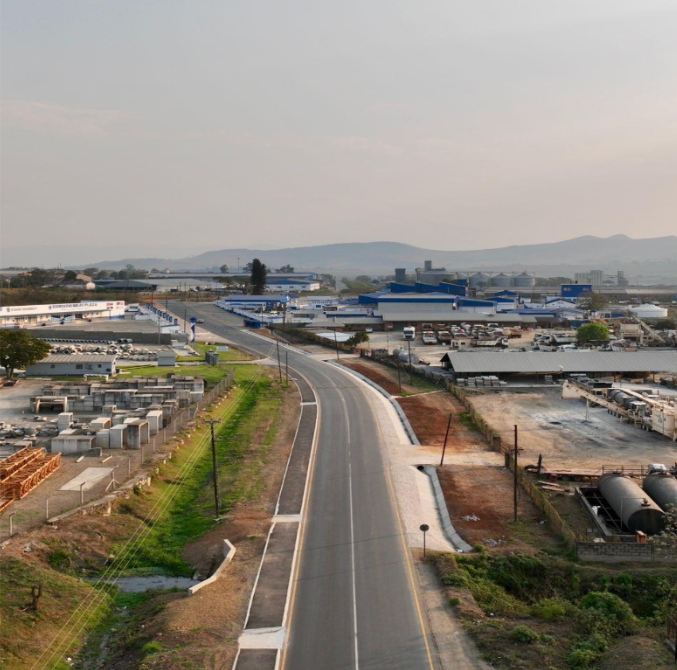
Infrastructure investment has been one of the clearest markers of Matsapha’s transformation. When municipal boundaries were extended in 2012 to include Tubungu Township, one of the most urgent needs was the poor state of access into the area. The construction of the Tubungu Access Road changed that, improving connectivity and opening the way for residential development, land ownership, and rising property values.
The municipality also constructed MR103 to ease congestion and improve one of the town’s key gateways. Beyond traffic flow, the project helped strengthen the image of Matsapha as a town prepared for growth. An efficient road network in an industrial centre is not simply about convenience. It is about productivity, movement of goods, investor confidence, and urban order.
Among the most significant interventions has been the rehabilitation of Matalatala Street and King Mswati III Avenue, a 3.2-kilometre project delivered at a cost of E33,522,937.27. The work included drainage systems, street furniture, and pedestrian walkways and was completed ahead of schedule and within budget. In a town whose economy depends on smooth logistics and movement, such infrastructure is not cosmetic. It is a direct enabler of commerce.
“The rehabilitation of Matalatala Street and King Mswati III Avenue covered 3.2 kilometres at a cost of E33,522,937.27.”
Planning for a more orderly urban future
Matsapha’s transformation has not only been driven by roads and factories. It has also required stronger planning systems. One of the most notable examples is the upgrading of Farm 105, now known as Likhwane Township, which had previously developed as an informal settlement without surveyed plots or formal tenure. Through township planning and upgrading, residents were given a pathway to formal land rights, bringing greater certainty, dignity, and opportunity for long-term household investment.
The development of the Matsapha Town Planning Scheme marked another major milestone. By providing clear development standards and guidelines, the scheme has helped ensure that growth in Matsapha is more orderly, more strategic, and better aligned to the municipality’s long-term future.
Service delivery that touches daily life
For Matsapha Municipality, service delivery is where urban development becomes visible in people’s daily lives. In a town with a large working population, including textile and factory employees, access to healthcare has been one of the most important service areas. More than 639,000 patients have been attended to through council-supported healthcare service providers, while 75 per cent of residents are able to access health services within a five-kilometre radius. These figures point to a municipality that is not only enabling economic activity but also responding to the social needs that come with urban growth.
“More than 639,000 patients have been attended to through council-supported healthcare service providers in Matsapha.”
“About 75 per cent of residents are able to access health services within a five-kilometre radius.”
Institutional capacity has also remained central to delivery. Matsapha Municipality has 112 active staff members out of an establishment of 121 positions. That workforce supports faster turnaround times on building plans and business licences, improved revenue administration, stronger project management, and more responsive municipal operations.
“The municipality currently has 112 active staff members out of an establishment of 121 positions, supporting service delivery and urban management.”
The street addressing project has added another layer to modern urban management. Through a comprehensive house and street naming system integrated into OpenStreetMap and Google Maps, Matsapha has improved navigation, emergency response, and business visibility, making the town more accessible and more functional in the digital age.
Environmental protection as part of growth
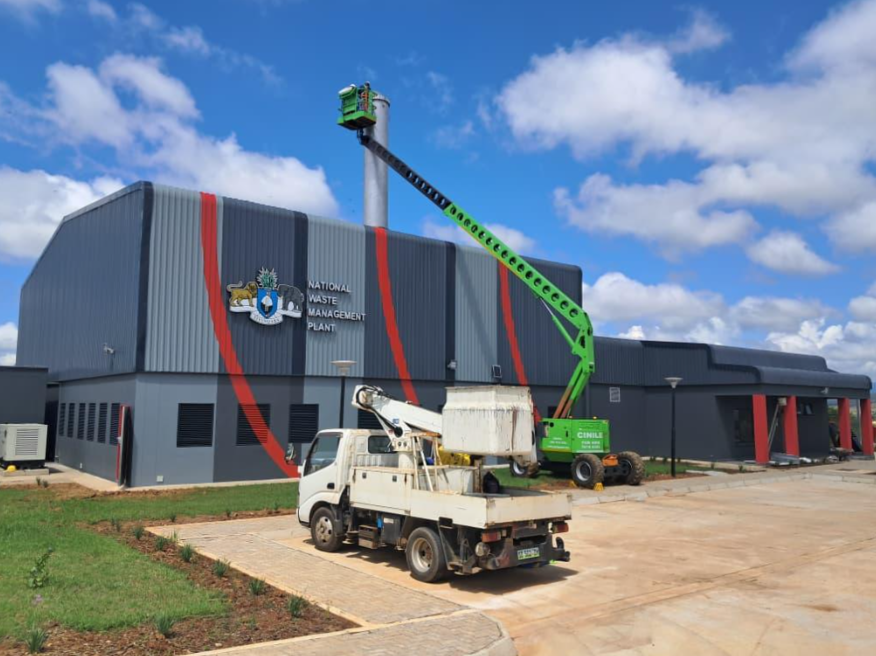
Matsapha’s development story is also being shaped by environmental responsibility. A major milestone has been the establishment of the Matsapha Healthcare Risk Waste Management Plant on Council Lot 1010, developed in partnership with the Ministry of Health and funded through the Global Fund via NERCHA. Inaugurated in 2026, the plant strengthens national capacity to safely manage hazardous medical waste, including infectious, pharmaceutical, and anatomical waste.
The municipality has also initiated the Matsapha Silent Park project to protect its largest wetland, covering about 15 hectares. The project includes fencing, indigenous tree planting, the removal of invasive species, and the development of walking trails and community recreation spaces. In an intensely industrial environment, this reflects a growing commitment to climate resilience, ecological stewardship, and public well-being.
“The Matsapha Silent Park project is protecting approximately 15 hectares of wetland as part of the town’s environmental sustainability agenda.”
Enterprise, inclusion, and community participation
Matsapha’s progress is not only defined by physical infrastructure. It is also visible in how the municipality is widening participation in the local economy. The Matsapha Business Forum has become an important bridge between the council and the business community, while also serving as custodian of the Matsapha CSI Fund to support community development priorities.
Youth inclusion has also taken a practical form. Through recycling initiatives aimed at moving unemployed young men away from crime and into structured work, the municipality has combined environmental action with livelihood creation. At the landfill, youth agriculture and compost production projects are helping turn waste into value while building skills and income opportunities.
The informal sector has likewise been brought more deliberately into the urban economy. Through the Matsapha Informal Trade Policy, the municipality has supported structured flea markets, stronger representation through Town Vending Committees, and more consistent engagement with traders. Five flea market events were successfully held in the 2025/26 period, while the 12th Annual Informal Traders’ Conference attracted 80 per cent of registered informal traders under the theme Trading Stronger Together.
“In 2025/26, Matsapha successfully hosted five flea market events, while the 12th Annual Informal Traders’ Conference attracted 80 per cent of registered informal traders.”
Governance that supports delivery
Behind every visible achievement is a governance system that makes delivery possible. Matsapha Municipality has strengthened its planning and administrative systems through its Integrated Development Plan, which is built around pillars such as financial viability, infrastructure, environmental sustainability, social development, spatial development, and local economic development.
The municipality has also maintained ISO 9001:2015 certification, an important sign of quality management, process discipline, and continuous improvement. For a municipality of Matsapha’s scale and importance, that consistency reinforces confidence in its capacity to manage growth with structure and accountability.
A town still building its future
Over the past 40 years, Matsapha has expanded not only in size but in purpose. It remains Eswatini’s industrial engine, but it is increasingly becoming something more: a planned urban centre with stronger systems, improving services, wider economic participation, and a clearer long-term development path. As the town continues to invest in infrastructure, sustainability, and inclusion, Matsapha is helping shape a more resilient urban future and a stronger national economy.
“With more than 720 formal businesses, 148 informal businesses and about 360 occasional traders, Matsapha remains a major centre of commerce and enterprise.”