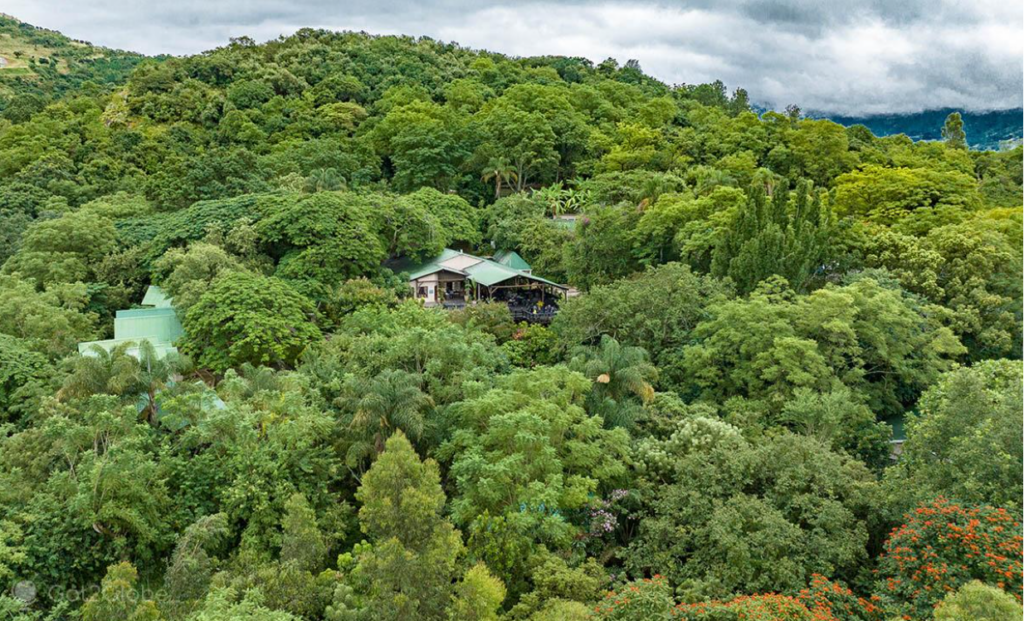
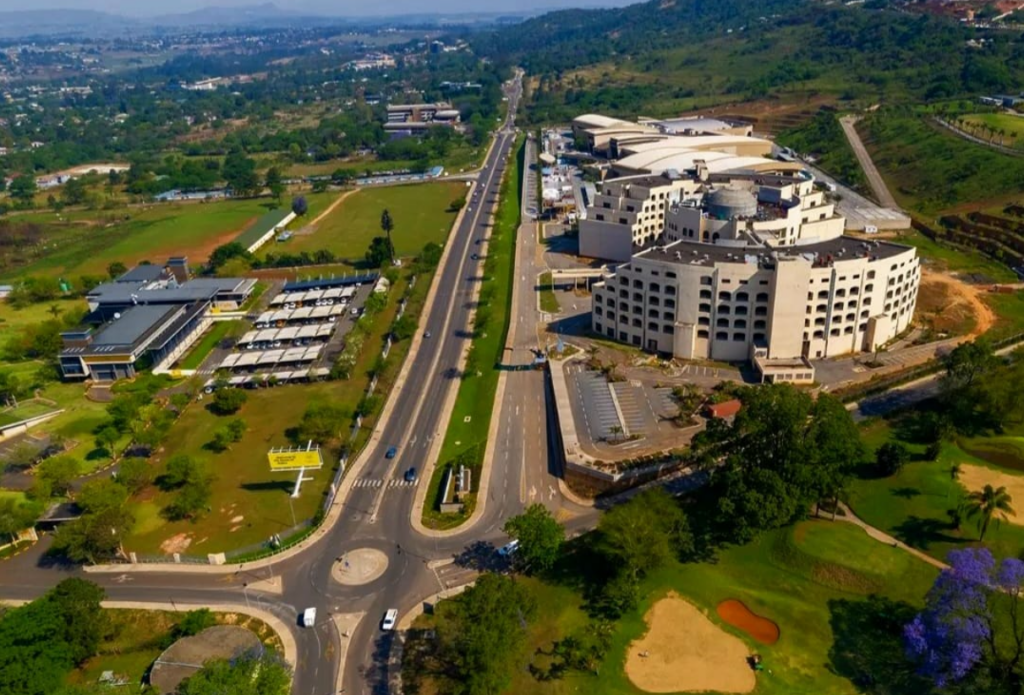
Few places in Eswatini carry the symbolism, prestige, and national visibility of Ezulwini. Long celebrated as the “Valley of Heaven”, the area has for decades stood as a showcase of natural beauty, leisure, and hospitality. But over the course of His Majesty King Mswati III’s 40 years on the throne, Ezulwini has steadily evolved into far more than a scenic passage between Mbabane and Manzini. Today, it is one of the kingdom’s most prominent mixed-use urban spaces, serving as a centre of tourism, diplomacy, corporate investment, and national events.
In the 1980s, Ezulwini still retained a distinctly semi-rural character. It was known more for its beauty and open landscape than for dense development. Yet even then, the valley had already begun building its national reputation through tourism assets such as the Royal Swazi Spa Complex, with its casino, convention facilities, and internationally recognised 18-hole golf course, while nearby attractions such as Mlilwane Wildlife Sanctuary strengthened its identity as a leisure and nature destination.
“Tourism was the original engine of Ezulwini’s rise, laying the foundation for the valley’s wider economic transformation.”
The turning point: formal urban recognition
A decisive milestone came in 1995, when the Ministry of Housing and Urban Development formally gazetted Ezulwini as an urban area at the Town Board level. That moment signalled official recognition that the valley was no longer simply a tourism strip. Commercial activity was growing, accommodation and retail were expanding, and demand for housing was beginning to rise as more people sought to live along the corridor linking the capital and the commercial centre.
That gazetting changed Ezulwini’s trajectory. It gave institutional shape to a place whose growth was accelerating and marked the beginning of a more deliberate urban future. The valley was no longer just admired for what it was naturally; it was now being planned for what it could become.
“1995 was a defining year for Ezulwini, marking its formal recognition as an urban area and setting the stage for structured expansion.”
From tourism strip to investment corridor
The 2000s deepened Ezulwini’s transformation. Its central location between Mbabane and Manzini made it increasingly attractive for residential estates, shopping centres, office developments, and other mixed-use investments. What had once been a largely tourism-led valley began to develop into a corridor of commerce and urban life.
A major symbol of that shift came in 2004, when His Majesty King Mswati III commissioned the Royal Villas, initially intended to host foreign dignitaries attending the SMART Partnership. The development included 14 villas and 57 guest houses, underscoring Ezulwini’s growing role not only in hospitality but also in diplomacy and national dialogue. It helped position the valley as one of Eswatini’s preferred addresses for major engagements.
“With 14 villas and 57 guest houses, the Royal Villas helped elevate Ezulwini into a recognised hospitality and dialogue hub.”
Stronger governance, stronger identity
As growth accelerated, Ezulwini required stronger governance and infrastructure. During the 2010s, municipal planning became more deliberate, while water and sewer investments were undertaken to respond to rising demand for services. In 2012, Ezulwini was upgraded to Town Council status, reflecting the scale of urban growth already underway.
This decade also saw visible commercial landmarks emerge. The Gables Shopping Centre strengthened the valley’s retail appeal, while the opening of MTN Eswatini Headquarters in 2013, named Mahlalekhukhwini House by His Majesty, reinforced Ezulwini’s rise as a corporate address of choice.
The story of Ezulwini from this period onward became one of diversification. Tourism remained central to its identity, but it was now being matched by finance, retail, institutional growth, and more permanent settlement.
“By 2012, Ezulwini’s growth had become impossible to ignore, earning it Town Council status and a stronger municipal mandate.”
The corporate turn of the 2020s
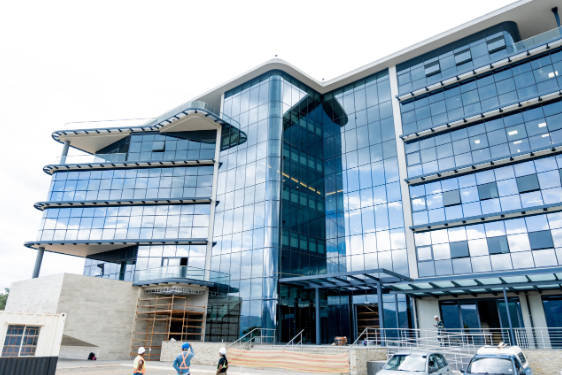
If earlier decades established Ezulwini’s tourism and urban credentials, the 2020s have sharpened its corporate and institutional identity. One of the clearest markers of this new phase came in June 2023, when Ezulwini Private Hospital opened, adding a major health-sector asset to the valley’s expanding profile. In the same year, the First National Bank Headquarters opened nearby, while the Examinations Council of Eswatini Headquarters and the Lubane Savings and Credit Cooperative building added to the area’s growing institutional footprint.
This momentum has continued into 2024, with the commissioning of works on the Central Bank of Eswatini complex and the anticipated opening of the ESCCOM Headquarters and the International Convention Centre. Together with a Five-Star Hotel development, these projects are pushing Ezulwini further into the ranks of a business, conference, and high-value hospitality hub.
“The 2020s have given Ezulwini a clear corporate turn, with the skyline increasingly shaped by major institutional investment.”
A place to live, not just to visit
Ezulwini’s rise has not only been visible in offices, hotels, and shopping centres. It has also been reflected in significant residential growth. Areas such as Goje Township, Mantenga Estates, Mndoni, Mukela, the Eco-Estate near Happy Valley Hotel, Spintex/Natex, and Mahlanganisa have strengthened the valley’s role as a place of permanent residence.
Most of this development has taken the form of medium- to low-density housing, creating fresh demand for higher-density options and rental accommodation. This is one of the strongest signs of Ezulwini’s urban maturity: it is no longer simply a destination people pass through or visit for leisure. It is increasingly a place where people live, work, and build their daily lives.
Growing diplomatic significance
Another important layer of Ezulwini’s growth is its diplomatic profile. The valley has become a preferred location for parts of the diplomatic corps, including a strong American presence, as well as the embassies of Qatar and Turkey, while the Finland consulate is also located within the valley. This international footprint adds another dimension to Ezulwini’s prestige and strategic importance.
“Ezulwini’s growth is not only commercial and residential; it is also diplomatic, with a growing international presence in the valley.”
Planning for the future
What makes Ezulwini’s journey especially notable is that its growth is increasingly being guided by policy and planning. Spatial development is anchored in Town Planning Schemes under the Town Planning Act of 1961. The outgoing 2018 scheme is being replaced by a new 2026 Town Planning Scheme, while a Comprehensive Mobility Plan signed in 2023 aims to address both vehicle growth and pedestrian safety. The municipality’s first Integrated Development Plan, developed in 2019, provided a longer-term framework for managing expansion and sustainability.
These measures reflect a municipality aware that growth brings both opportunity and pressure. Traffic congestion, land constraints, insufficient public facilities, lack of a final waste disposal site, limited cemetery space, and the absence of a dedicated public transport station all point to the challenges of success. Yet they also highlight an urban centre actively working to shape its future rather than merely reacting to it.
A valley transformed
Four decades into His Majesty’s reign, Ezulwini stands as one of the clearest examples of urban transformation in Eswatini. Its story is one of continuity and reinvention: a valley built on tourism and beauty, but one that has steadily expanded into diplomacy, finance, health care, institutional investment, and residential growth. The Valley of Heaven has not lost its identity. Rather, it has broadened it.
Today, Ezulwini is not only one of Eswatini’s most iconic destinations. It is also one of its most strategic. And as new projects continue to reshape its skyline and strengthen its economic role, the valley’s journey remains one of the most visible expressions of national progress over the past 40 years.
Share this post
Subscribe to our newsletter
Keep up with the latest blog posts by staying updated. No spamming: we promise.